The Pricing Structure of the 1944 Walking Liberty Half Dollar
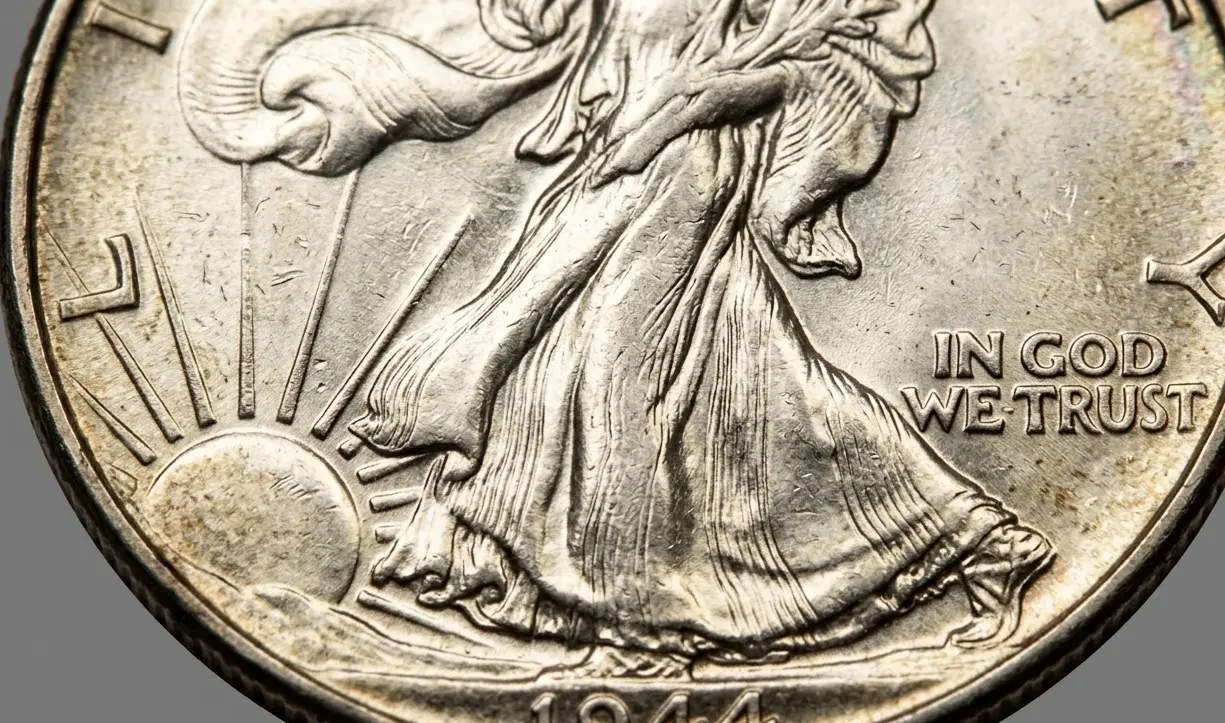
The current 1944 Walking Liberty Half Dollar value depends on three primary factors: the mint location, physical state on the Sheldon scale, and visual strike characteristics.
| Parameter | Value |
| Metal | Silver (90% purity) |
| Weight | 12.50 grams |
| Pure Silver Content | 11.25 grams |
| Diameter | 30.60 millimeters |
| Edge Type | Reeded |
Any weight deviation exceeding 0.259 grams indicates critical wear or potential counterfeiting.
Emission Statistics by Production Centers
Three main branches of the US Mint operated in 1944, each using a specific identifier.
- Philadelphia — no mint mark
- Denver — D mark
- San Francisco — S mark
Total production reached 46,925,000 units.
Mintage distribution follows this pattern:
Philadelphia: 28,206,000 units
Denver: 9,769,000 units
San Francisco: 8,950,000 units
High output in Philadelphia ensures a constant supply of low to mid-grade coins on auction platforms.
Correlation Between Preservation and Market Quotes
Market value demonstrates exponential growth when moving from AU categories to MS categories.
Below is the pricing structure for coins without a mint mark (Philadelphia).
- Grade XF 40 — $14.00
- Grade AU 58 — $20.00
- Grade MS 63 — $35.00
- Grade MS 65 — $95.00
- Grade MS 67 — $650.00
Reaching MS 68 status, the price stabilizes at $12,500.00 or higher.
Mathematical price progression:
MS 63 → MS 65: 171% increase
MS 65 → MS 67: 584% increase
MS 67 → MS 68: 1823% increase
Such dynamics result from the critical reduction of surviving coins in perfect condition.
Specifics of Denver Issues (1944-D)
Coins carrying the D mark often feature sharper execution compared to other mints.
Pricing grid for 1944-D:
| Grade | Price in USD |
| MS 64 | $55.00 |
| MS 65 | $110.00 |
| MS 66 | $185.00 |
| MS 67 | $525.00 |
| MS 68 | $9,000.00 |
Auction records for 1944-D in MS 68 condition peaked at $11,400.00.
Strong mint luster and an absence of micro-scratches on the fields remain mandatory requirements for these price levels.
Characteristics of San Francisco Mintages (1944-S)
San Francisco issues traditionally represent the most difficult finds in high quality due to period-specific production methods.
Using worn dies often produced coins with weak central detail strikes.
Logic chain for 1944-S evaluation:
Weak strike → Missing details on Liberty’s hand → Lower grade → Price drop.
Market indicators for 1944-S:
- MS 63: $45.00
- MS 65: $210.00
- MS 66: $550.00
- MS 67: $2,800.00
The price difference between MS 66 and MS 67 stands at 409%.
Record sales for a 1944-S specimen in MS 67+ condition reached $38,400.00 at Heritage Auctions.
Full Steps and Detail Strike Factors
Specific zones on the obverse and reverse remain critical for the Walking Liberty series.
Control zone list:
- Fingers on Liberty’s left hand
- Head and dress folds
- Eagle’s breast feathers
- Sun rays
Coins possessing full detail in these zones receive a 20–50% premium over base catalog values.
Specimens lacking detail on Liberty’s hand trade at a discount even with high technical grades.
Comparative Analysis of Annual Price Volatility
Silver investment coin markets show stability with moderate growth in the Top Pop segment.
Average annual value changes for various categories:
| Category | Annual Growth/Decline |
| Circulated | ± 2% (silver metal price dependent) |
| MS 60 – MS 64 | + 4% |
| MS 65 – MS 66 | + 7% |
| MS 67 and higher | + 12% |
Over the last ten years, the value index for MS 67 coins rose by 145%.
This trend confirms the status of high-grade coins as a protective asset.
Investment Risks and Authenticity Verification
Significant quantities of fakes and coins with artificially altered surfaces circulate in the market.
Verification processes include the following steps:
- Weight measurement on electronic scales accurate to 0.01 grams
- Visual edge inspection checking for seams
- Mint mark placement comparison against reference samples
- Database verification through certified laboratories
Utilizing professional certification from PCGS or NGC is standard for transactions exceeding $100.00.
Holding cases ensure liquidity and protect the silver metal from oxidation.
Impact of Toning on Pricing
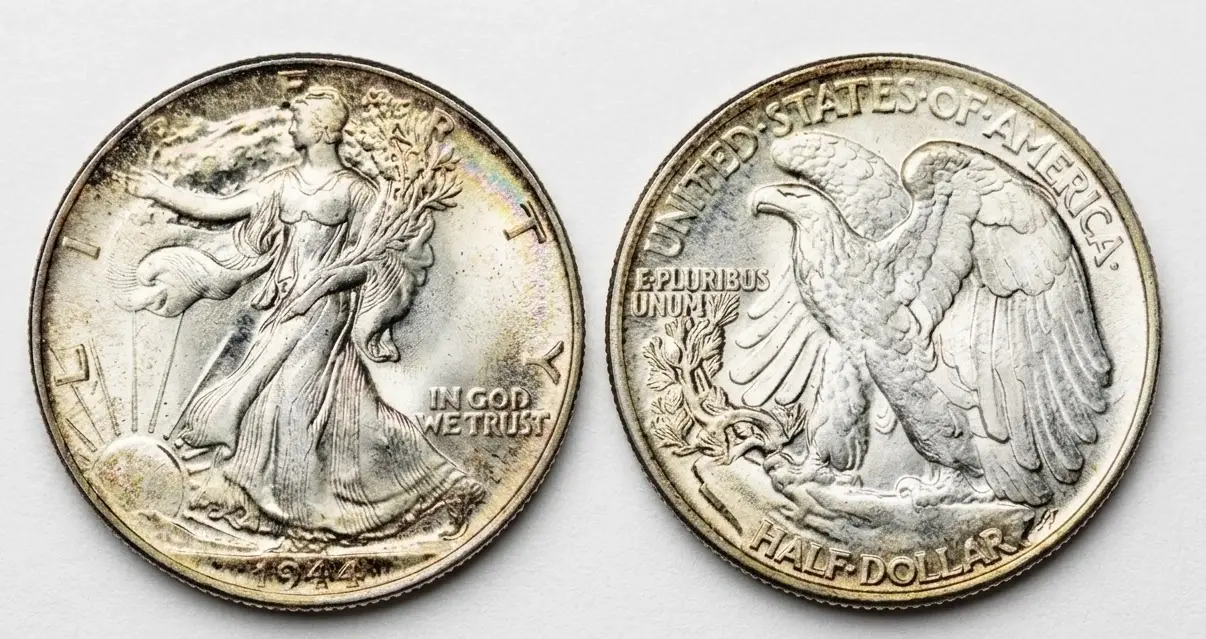
Natural silver metal oxidation caused by environmental exposure forms a toning layer.
Toning types and their price impact:
Rainbow toning → 30–100% price increase
Dark, uneven toning → 15–20% price decrease
Cleaning marks (Blast White via chemicals) → 50–70% price decrease
Cleaning a coin completely destroys its collector value, moving the item into the silver metal scrap category — see it inside the coin appraisal app.
Survival Statistics
Certified coin counts for 1944 show uneven distribution according to major grading services.
Population distribution for 1944 (Philadelphia):
Total certified: ~45,000 units
MS 65: 12,400 units
MS 66: 18,500 units
MS 67: 3,200 units
MS 68: 14 units
The extremely low number of MS 68 specimens explains the sharp price jump from $650.00 to five-figure sums.
Final Classification of Price Levels
The market is segmented into three independent tiers.
First tier — coins valued under $50.00.
Includes all specimens up to MS 63 grade.
Price correlates with global silver metal exchange rates.
Second tier — coins from $100.00 to $1,000.00.
Covers specimens in MS 65 and MS 66 grades.
Primary segment for private investors.
Third tier — auction rarities starting at $2,500.00.
MS 67 grades and higher.
Objects for long-term institutional capital placement.
Technological Causes for High-Grade Rarity
1944 production processes involved dropping finished coins into common bins.
Mechanical damage from coin-to-coin contact (Bag Marks) limits the number of specimens reaching grades above MS 65.
Large marks on Liberty’s face or the eagle’s center automatically exclude a coin from the top price range.
Concentrated small defects on the fields also lower the final grade.
Trading Dynamics and Seasonal Fluctuations
Large numismatic auction data from 2020 through early 2026 reveals demand cycles.
Maximum prices occur during the first quarter during major national conventions.
Activity declines in summer months, leading to 3–5% price corrections.
Investors should complete purchases during market lulls to optimize entry costs.
Strategic Pricing and Auction Trends
Reviewing current 2026 data inside the free coin app shows a tightening of the MS 67+ market.
Buyers focus on eye appeal over technical numbers.
Specimens with “Cactus” or “Gold” toning premiums command higher premiums than white coins.
Market stability remains tied to the scarcity of the S-mint in high strike quality.
Strike Quality vs Grade Numerical Value
A coin might possess an MS 66 technical grade while appearing flat.
Flatness reduces marketability.
Purchasers in 2026 prioritize “Full Strike” designations over raw numerical scores.
This preference creates secondary price layers within the same grade.
Long-term Silver Metal Value Floor
Intrinsic value provides a safety net for low-grade coins.
Even at zero numismatic premium, the 11.25 grams of silver metal maintain a baseline price.
Industrial demand for silver metal keeps this floor rising over decades.
Rare dates utilize this floor as a foundation for their collector premiums.
The current 1944 Walking Liberty Half Dollar value depends on three primary factors: the mint location, physical state on the Sheldon scale, and visual strike characteristics. Parameter Value Metal Silver (90% purity) Weight 12.50 grams Pure Silver Content 11.25 grams Diameter 30.60 millimeters Edge Type Reeded Any weight deviation exceeding 0.259 grams indicates critical wear…